A knee that hurts every morning, every staircase, every step — that is not something you have to accept. Robotic knee replacement can give you your life back, with more precision and less pain than ever before.
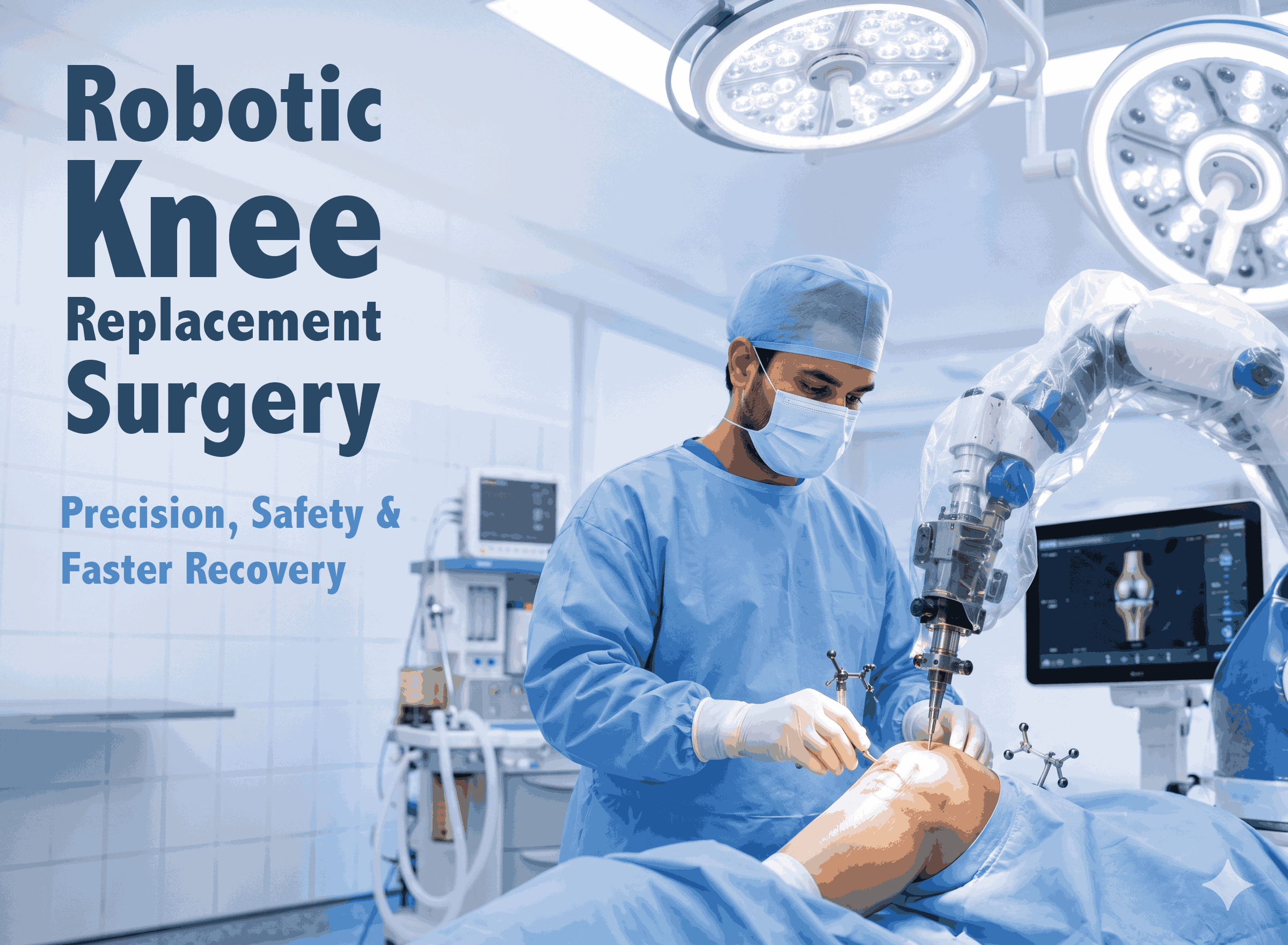
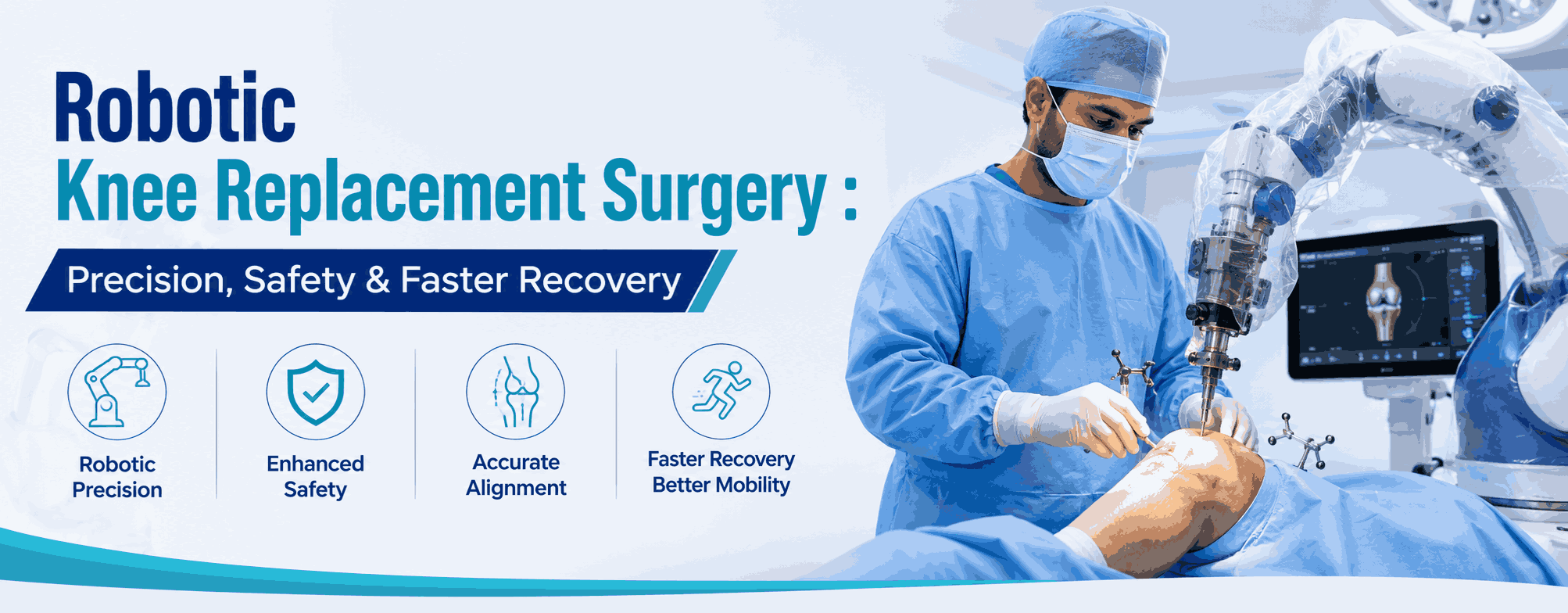
Traditional knee replacement is one of the most successful surgeries in medicine. But it has always depended on the surgeon's hands and real-time judgement to position the implant correctly — in a joint that is entirely unique to each patient. Robotic-assisted knee replacement changes this by combining surgical expertise with a computer-guided robotic arm that plans and executes every cut to submillimetre precision.
The robotic system never acts independently. The surgeon is always in full control — the robot simply ensures every movement stays precisely within a pre-planned surgical boundary, preventing even minor deviations that could affect the implant's long-term performance.
Read More: Silent Warning Signs of Kidney Disease Most People Ignore Until It's Too Late
| Feature | Details |
| Implant Positioning Accuracy | Within 1 mm, compared to a 3–4 mm variation in traditional knee replacement surgery. |
| Walking After Surgery | Most patients can walk with support within 24 hours of surgery. |
| Expected Implant Lifespan | Up to 25 years, thanks to optimal implant alignment and precise positioning. |
| Typical Hospital Stay | Usually 3–5 days, which is generally shorter than traditional knee replacement surgery. |
| Feature | Traditional Knee Replacement | Robotic Knee Replacement |
| Surgical Planning | X-rays and surgeon assessment | 3D CT-based, patient-specific digital plan |
| Implant Precision | 3–4 mm variance possible | Accurate to within 1 mm |
| Bone Preservation | Standard bone removal | Minimal bone removal—only what is necessary |
| Post-Operative Pain | Higher due to greater soft tissue trauma | Lower due to minimal soft tissue disruption |
| Hospital Stay | 5–7 days | 3–5 days |
| Implant Lifespan | 15–20 years | 20–25 years |
| Natural Knee Feel | Good in most cases | Higher patient satisfaction and a more natural knee feel |
| Benefit | How It Helps You |
| Perfectly Fitted Implant | Planned for your specific knee anatomy—not a one-size-fits-all approach. |
| Less Pain | Minimal soft tissue trauma means significantly less post-operative pain and fewer pain medications. |
| Walk Sooner | Most patients take their first assisted steps within 24 hours of surgery. |
| Bone Preserved | Only the minimum necessary bone is removed—important for long-term stability. |
| Lasts Longer | Optimal alignment extends implant life to 20–25 years, reducing revision surgery risk. |
| Home Faster | A shorter hospital stay of 3–5 days means you return home and begin rehabilitation sooner |
You may be a candidate for robotic knee replacement if you experience:
Read More: Silent Heart Attack: Warning Signs
| Important Consideration | Details |
| Age Is Not a Barrier | Robotic knee replacement is suitable from the late 40s onwards. Younger, active patients benefit most from the longer-lasting robotic implants. |
| Don't Wait Too Long | Early consultation allows for staged treatment—beginning conservatively. Earlier intervention always produces better outcomes. |
| Timeframe | Recovery Milestone |
| Day 1 | Stand and take your first assisted steps with a physiotherapist's support. |
| Days 2–5 | Walk with a walker, begin knee-bending exercises, and most patients are discharged between Days 3–5. |
| Weeks 2–6 | Continue progressive physiotherapy, experience reduced swelling and pain, and gradually walk without aids. |
| Weeks 6–8 | Return to driving and most daily activities. |
| 3–6 Months | Achieve full recovery, walk freely, climb stairs comfortably, and resume normal life. |
| Important Information | Details |
| Physiotherapy Matters | Surgery gives you a new knee. Physiotherapy teaches you to use it. TMU Hospital's rehab team designs a programme specific to your age and fitness level. |
| Ayushman Bharat / Insurance | TMU Hospital is empanelled under PMJAY and all major TPAs. Our Empanelment team handles all paperwork and cashless approvals. Call 1800-570-6768. |
Book Your Robotic Knee Replacement Consultation
Stop living with knee pain. One appointment at TMU Hospital's Joint Replacement Department could be the first step toward walking freely again.
Read More: Cervical Cancer Is Preventable: HPV Vaccine, Screening & Early Signs
Q1. Is robotic knee replacement surgery safe?
Answer: Yes, robotic knee replacement has an excellent safety profile and is performed routinely across India's leading hospitals. The robotic system enhances safety by ensuring every surgical movement stays within pre-planned boundaries, reducing the risk of tissue damage. At TMU Hospital, it is performed by experienced senior orthopaedic surgeons with full critical care support available.
Q2. How long does the surgery take?
Answer: The procedure takes approximately 1.5 to 2 hours, which is similar to traditional knee replacement surgery. The additional precision comes from the pre-operative 3D planning completed before the day of surgery, not from extra time in the operating theatre.
Q3. What is the minimum age for knee replacement?
Answer: There is no strict minimum age for knee replacement. The decision is based on the severity of your knee condition and its impact on your quality of life. The longer-lasting implants made possible by robotic precision are making the procedure increasingly appropriate for patients in their late 40s and 50s with severe arthritis.
Q4. Will I walk normally again?
Answer: Yes. The vast majority of robotic knee replacement patients at TMU Hospital report significantly improved walking ability and pain elimination within 3 to 6 months. Many describe their new knee as feeling more natural than expected—a direct result of the anatomically precise robotic implant placement.
Q5. Is it covered under Ayushman Bharat or insurance?
Answer: TMU Hospital is empanelled under Ayushman Bharat (PMJAY) and all major health insurance companies and TPAs. Coverage depends on your specific policy. Our Empanelment Department verifies eligibility and manages all pre-authorisation and claim processing. Call 1800-570-6768 to check your coverage before your consultation.
Q6. Is the knee joint completely replaced during robotic knee replacement surgery?
Answer: No. It is a common misconception that the entire knee joint is replaced. In reality, robotic knee replacement involves resurfacing the damaged portions of the knee joint. The worn-out surfaces are carefully removed and replaced with metal components, along with a smooth cushioning insert between them. This restores joint function while preserving as much healthy bone as possible.
Q7. Did you replace my knee joint?
Answer: It is a misnomer; we are not actually replacing it, but rather resurfacing it. In this procedure, we remove part of the knee joint and replace it with metal and a cushion in between.

HOD
Department: Joint Replacement
Qualifications: MBBS, MS (Orthopaedic), FIAP, FISM, FIPM</br>Chief - Robotic joint Replacement
 Bone Mineral Density (BMD): A Crucial Ma...
© TMU Hospital is Proudly Owned by TMU